|
Enabling Intelligent AGV & AMR Systems with SMARC 2.2 Modules Featuring Intel Atom® x7000E/RE Series |
|
|
|
|
|
|
|
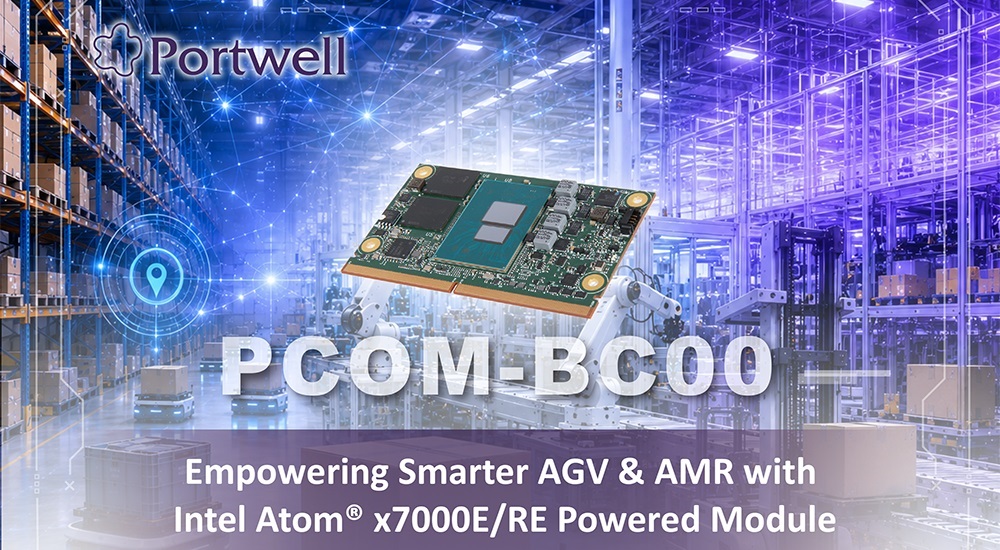
The rapid adoption of Industry 4.0, smart manufacturing, and intelligent warehousing is accelerating the deployment of automated guided vehicles (AGV) and autonomous mobile robots (AMR) worldwide. Unlike conventional material handling equipment, today’s AGVs and AMRs are expected to navigate autonomously, avoid obstacles, communicate with factory management systems, and perform real-time decision-making with minimal human intervention. To achieve these capabilities, modern mobile robots must integrate multiple sensors like cameras, LiDAR, IMUs, and encoders. At the same time, they need to execute localization, path planning, and motion control. Consequently, these workloads require compact embedded computing platforms. These platforms must deliver reliable processing, deterministic responsiveness, low power consumption, and long-term availability. Why Computer-on-Modules Are Well-Suited for AGV & AMR Designs For applications that benefit from hardware scalability and processor upgrade flexibility, computer-on-modules offer a practical path to improving computing performance while preserving application-specific carrier board designs, significantly reducing engineering effort and shortening time-to-market. For AGV and AMR platforms, developers also require robust high-speed connectivity for multiple sensors and peripherals. Specifically, camera interfaces enable machine vision and object recognition. Meanwhile, CAN Bus remains a widely adopted communication interface for motor controllers, battery management systems, and industrial control devices. In addition, high-speed Ethernet supports fleet management and edge-to-cloud communication. Furthermore, multiple PCIe lanes provide flexibility for additional AI accelerators, wireless modules, or custom I/O expansion. Consequently, these requirements make computer-on-modules an increasingly attractive architecture for compact autonomous mobile systems. Portwell SMARC 2.2 Module Delivers Performance & Connectivity Required for AMR Powered by Intel Atom® x7000E/RE processors with up to 8 CPU cores and a configurable 6W–15W TDP, PCOM-BC00 delivers an optimized balance between computing performance and energy efficiency, helping maximize battery life for autonomous mobile platforms. The module integrates up to 16GB onboard LPDDR5 memory and up to 256GB onboard eMMC 5.1, enabling fast boot times, reliable local storage, and responsive execution of navigation and control software. Its extensive I/O configuration supports the diverse connectivity requirements of mobile robots, including 4 PCIe Gen3 x1, 2 USB 3.2 Gen2, 6 USB 2.0, dual 2.5GbE, 2 UART, SATA, and triple display outputs, anchored by a standard DP++ with SKU specific options for HDMI®/DP and eDP/LVDS. More importantly, the inclusion of MIPI-CSI support allows direct integration of compact industrial cameras for vision-based navigation, obstacle detection, barcode recognition, and AI inspection. The optional CAN bus interface further simplifies communication with motor drives, battery management systems, and motion controllers, reducing overall system complexity. Building Smarter Autonomous Mobile Systems with PCOM-BC00 Portwell PCOM-BC00 SMARC 2.2 module addresses these challenges by integrating Intel Atom® x7000E/RE processors with modern industrial connectivity, power-efficient operation, and a highly modular architecture. Whether deployed in warehouse logistics, factory automation, semiconductor manufacturing, electronics assembly, or intelligent material handling, PCOM-BC00 enables OEMs and system integrators to develop compact, reliable, and scalable AGV and AMR solutions with shorter development cycles and lower total cost of ownership. By combining efficiency, flexibility, and industrial-grade reliability, PCOM-BC00 provides an ideal embedded computing platform for intelligent AGV and AMR systems, helping accelerate development while supporting long-term deployment requirements. PCOM-BC00 SMARC 2.2 Module
Intel and Intel Atom are trademarks of Intel Corporation. All other products and company names referred to herein may be trademarks or registered trademarks of their respective companies or mark holders. |
|

-
Products
-
Computer-On-Module
- COM-HPC Modules
- COM Express & ETX Modules
- Qseven Modules
- SMARC Modules
- SODIMM SOMs
- MicroSOM Modules
Industrial PC Products
- Single Board Computers (SBC)
- Industrial Backplanes
- Industrial Chassis
- Industrial Power Supplies

Embedded Computing
- Embedded Systems
- Mini-ITX Boards
- Mini-ITX Boards Low Power
- Nano-ITX Boards
- NUC Boards
- 3.5" ECX/Pico-ITX/Femto-ITX
- Industrial ATX/FlexATX/MicroATX Boards
Medical Computers
- Medical Computers
Gaming Appliances
- Gaming Appliances

Network Appliance
- X86 Platforms
- Network & Bypass Cards
- 4G LTE Modules
- LCD Modules
Server
- Servers
- Server Motherboard
INTELLIGENT SYSTEMS
- Industrial IoT Appliances
- Edge AI & Industrial GPU Computers

Human Machine Interfaces
- Medical Displays
- Medical Panel PCs
- Industrial Monitors
- Industrial Panel PCs
Industrial I/O
- Industrial I/O
- Contec Industrial I/O
INDUSTRIAL FLASH & MEMORY
- Industrial SSD

-
- Solutions
- Support Center
- Contact Us
- About Us


1-877-APT-8899
1-510-403-3399
info@portwell.com
Copyright © by American Portwell Technology, Inc. All Rights Reserved